

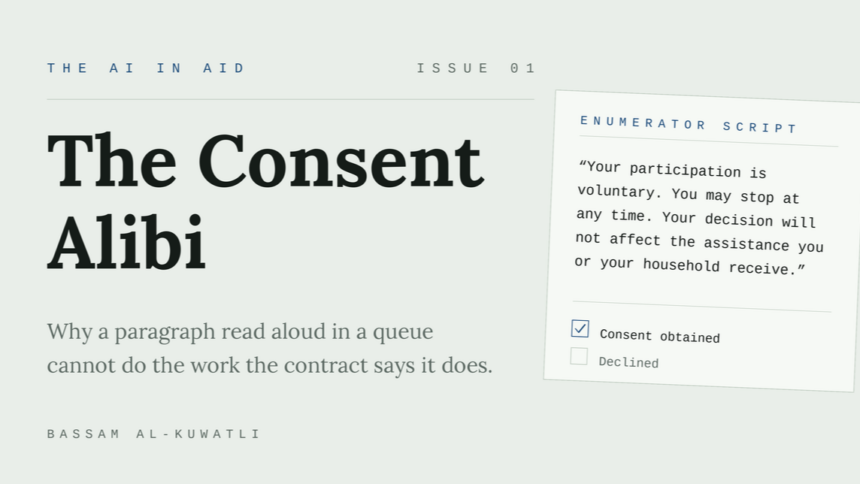
Mr. Bassam al Kuwatli, Chief Executive Officer @ BlueDesk graciously granted Madani Newsroom permission to republish his article.
Artificial intelligence is making its way into humanitarian programmes through the organisations that are least able to push back against it. And somehow, the little consent paragraph at the top of every survey has become the moral and legal justification for all of it.
Every survey my teams conduct starts the same way.
An enumerator reads a short statement explaining who we are, why we’re asking questions, what will happen to the answers, and that participation is voluntary.
“You may refuse to participate. You may stop at any time. Your decision will not affect the assistance you or your household receive.”
The respondent agrees. A box is ticked. Another dataset is created.
I’ve approved that paragraph hundreds of times over the years. I’ve seen it translated into multiple languages and inserted into countless contracts and survey forms.
And I’ve gradually come to believe that it does far less than we pretend it does.
This is not the fault of enumerators. Most read the script carefully and respectfully. Nor is it the fault of respondents, who often understand perfectly well what is being said.
The problem is the situation itself.
If someone is standing in a queue for food assistance, cash support, shelter, or legal services, and the organisation asking the questions appears connected to the organisation providing the assistance, then the power imbalance is obvious. Whether anyone intends it or not, people naturally assume there may be consequences if they refuse.
To read the full article: (4) The Consent Alibi | LinkedIn